During extremely hot and humid weather, your body's ability to cool itself is challenged. When the body heats too rapidly to cool itself properly, or when too much fluid or salt is lost through dehydration or sweating, body temperatures rise and you or someone around you may experience a heat-related illness.
One of the most important things to do is drink a lot of fluids (mostly water or some low-calorie electrolyte drinks) a day or two before you plan to be outside for a prolonged period. If you are dehydrated when you start work, you may not be able to drink enough to catch up with your body’s need for water.
DART Staff Refuge Areas
Transit centers are open to the public to cool off. All DART staff working during the tournament will have access to designated refuge areas. These spaces are intended for you to take a seat, rest, cool off, and grab cold water and snacks. Refreshments and snacks at all refuge areas are designated for our ambassadors and frontline staff only.
| Station | Refuge Location |
| Addison Station | Transit Center (extended hours) |
| Akard | 1st Floor Break Room - Room 1010 |
| Lake June | Transit Center |
| CityLine/Bush | DART Non-Revenue Vehicle* |
| Cityplace/Uptown | DART Non-Revenue Vehicle* |
| DFW | DART Non-Revenue Vehicle* |
| Downtown Carrollton (2 platforms) | DART Non-Revenue Vehicle* |
| Downtown Irving/Heritage Crossing | Transit Center (extended hours) |
| EBJ/Union Station | 1st Floor Conference Room |
| Fair Park | DART Cooling Bus (STAFF ONLY) |
| MLK Jr. | Transit Center and DART Cooling Bus (STAFF ONLY) |
| Parker Road | Transit Center (extended hours) |
| Pearl/Arts District | DART Cooling Bus (STAFF ONLY) |
| SMU/Mockingbird | DART Cooling Bus (STAFF ONLY) |
| St. Paul | Walk to Akard or Pearl/Arts District |
| Victory | DART Cooling Bus (STAFF ONLY) |
| West Transfer Center | Transit Center (regular hours) |
*obtain key from Station Captain or Station Concierge
Heat Exhaustion/Stroke Symptoms
It is important to know the symptoms of extreme heat exposure and the appropriate responses. The Centers for Disease Control and Prevention (CDC) provides a list of warning signs and symptoms of heat illness, and recommended first aid steps. Some of these symptoms and steps are listed below.
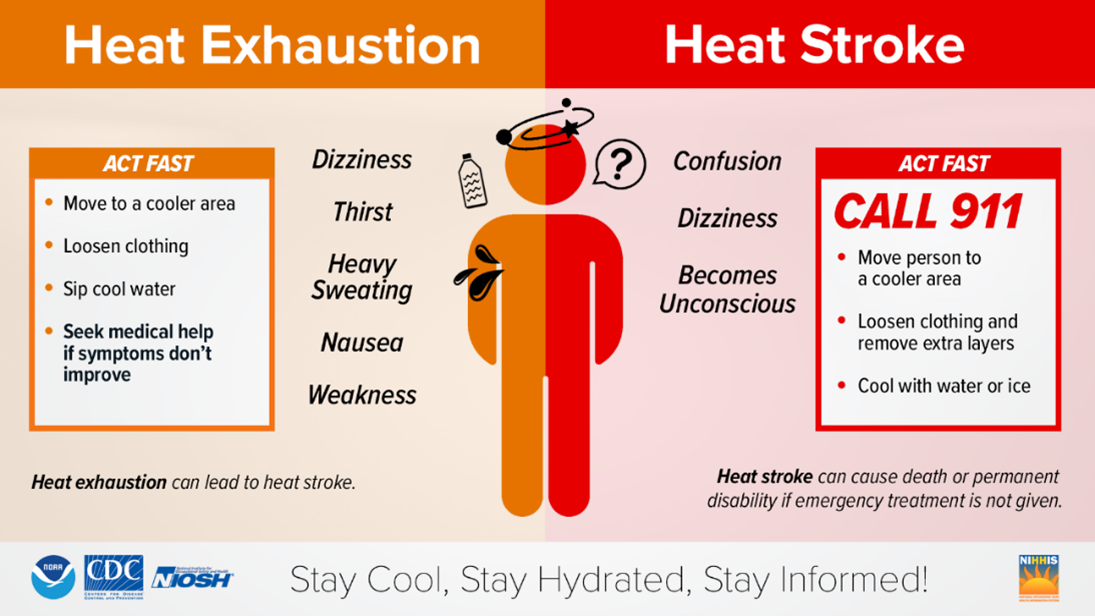
Heat Exhaustion
- Symptoms: Heavy sweating; weakness or tiredness; cool, pale, clammy skin; fast, weak pulse; muscle cramps; dizziness, nausea or vomiting; headache; fainting.
- First Aid: Move person to a cooler environment, preferably a well air-conditioned room. Loosen clothing. Apply cool, wet cloths. Offer sips of water. Seek immediate medical attention if the person vomits, symptoms worsen or last longer than 1 hour.
Heat Stroke
- Symptoms: Throbbing headache; confusion; slurred speech; nausea; dizziness; body temperature above 103°F; hot, red, dry or damp skin; rapid and strong pulse; fainting; loss of consciousness.
- First Aid: Call 911 or take the victim to a hospital immediately. Heat stroke is a severe medical emergency. Delay can be fatal. Move the victim to a cooler, preferably air-conditioned environment. Reduce body temperature with cool cloths. Use fan if heat index temperatures are below the high 90s. A fan can make you hotter at higher temperatures. Do NOT give fluids.
Using a fan to blow air in someone’s direction may actually make them hotter if heat index temperatures are above the 90s. For more information on all of these heat related illnesses, see the Centers for Disease Control and Prevention (CDC) site.













 Translate